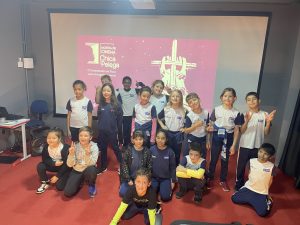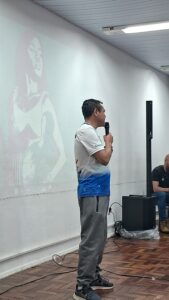
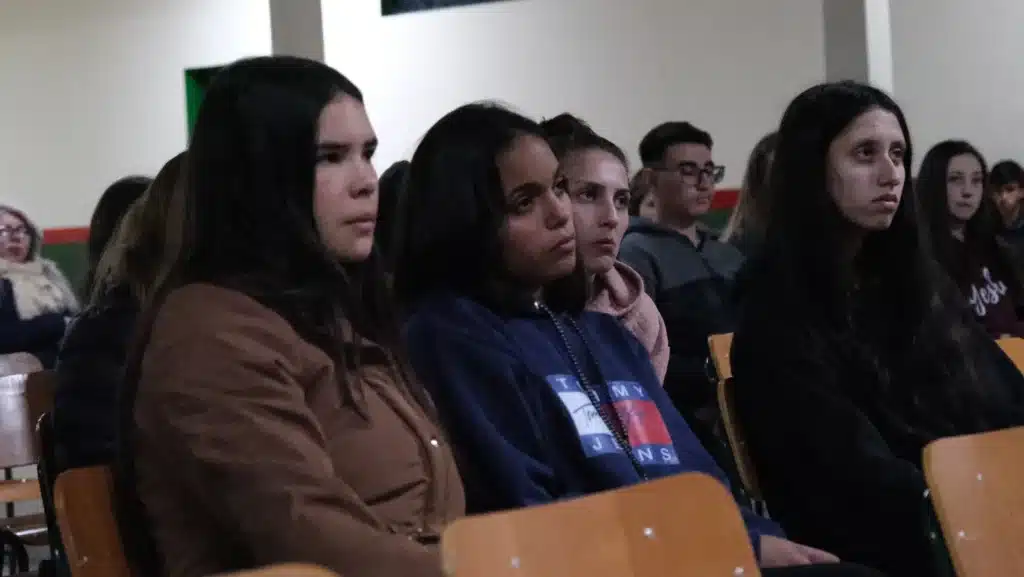

More than 1,750 students, from dozens of municipal and state schools, filled the sessions of the 2nd Chica Pelega Film Festival. They came from within the city and from the roads of the countryside, from century-old schools and rural centers, to turn the dark room into a classroom. Before the thanks, a portrait of those who were there — a bit of the history and daily life of each one.
Campos Novos — session of April 11
CAIC Professora Nair da Silva Gris. A downtown municipal school, it serves about 780 students from 1st to 9th grade of elementary school. It has already set its sights far beyond the cinema screen: in 2019, it represented Campos Novos at the 27th Rocket Journey, in Piraí (RJ), placing students from the Santa Catarina countryside in the country’s largest PET-bottle rocket competition.
Escola Municipal Santa Júlia Billiart. In the Nossa Senhora Aparecida neighborhood, the school has operated in the same building since 1973 and gathers around 600 children and teenagers, from early childhood education to 9th grade, with classrooms and structure adapted to welcome students with disabilities. The name honors Saint Julie Billiart, a French founder dedicated to educating poor children — a vocation the school carries to this day.
Escola Municipal Novos Campos. An elementary school (early and final years), it is part of the municipal network that made Campos Novos a national reference in learning assessments. It bets on technology in the classroom, with broadband internet and notebooks for students.
EEB Paulo Blasi. The dean of Campos Novos education. Established on July 15, 1934, as the Gustavo Richard School Group — in the first walls artisanally raised in rough stone — it turned 90 in 2024. It is today the largest in the region: about 980 students and 80 teachers in three shifts, from elementary to regular, innovative and technical high school (commerce and teaching). A school that collects stories spanning generations.
EEB Professora Antônia Correa Mendes. A state elementary school in the Bela Vista district, it brings education far from the urban center, with computerized classrooms and a library for a rural community.
EEB Henrique Rupp Júnior. In the Senhor Bom Jesus neighborhood, the state school serves about 660 students in elementary, high school and special education. Named in honor of Santa Catarina politician Henrique Rupp Júnior, it has undergone renovation and expansion of its structure in recent years.
EEB Coronel Gasparino Zorzi. One of the largest state schools in the city, in the São Sebastião neighborhood: about 850 enrollments and nearly 70 teachers (2024 Census), from elementary to high school. It likes to open the school to the world — it has already dedicated an entire project to studying the culture of the countries that competed in the Olympic Games.
EEB Professora Virgínia Paulina da Silva Gonçalves. Based in Monte Carlo, a neighboring municipality that is part of the same Campos Novos regional area, the state school is a hub of projects: it has already hosted the Regional Mathematics and Science and Technology Fair, with dozens of schools and hundreds of exhibiting students.
CEJA — Youth and Adult Education Center of Campos Novos. In the Senhor Bom Jesus neighborhood, it is the school for those who returned to their studies. It offers elementary and high school in the supplementary mode, in three shifts, for young people and adults who resume their school journey — proof that the classroom (and the cinema) has no age.
CEJA — Monte Carlo Decentralized Unit. A branch of CEJA that brings youth and adult education to Monte Carlo, bringing closer to home those who need to balance studies with work.
Curitibanos — sessions of April 18 and 19
Núcleo Municipal do Campo Leoniza Carvalho Agostini. A rural school in the Marombas Bossardi locality, in the countryside of Curitibanos, it serves more than 200 students of early childhood and elementary education, bringing together the municipal and state networks. It recently gained a soccer field and a renovated gymnasium — a center of life for the entire rural community.
Núcleo Municipal Professora Teresa Lemos Preto. In the Nossa Senhora Aparecida neighborhood, it offers early childhood and elementary education, with a science lab, art studio and, now, a newly inaugurated soccer field.
Núcleo Municipal Getúlio Vargas. From preschool to elementary school, the municipal school in the Getúlio Vargas neighborhood bets on reading, arts and sustainability — its students have even gone to the City Council to learn, in practice, how the city’s politics works.
EEB Professor Antônio Francisco de Campos. A state school in downtown Curitibanos, dedicated to elementary school, early and final years, with a large library, covered court and multifunctional resource room for specialized educational assistance.
EEB Marechal Eurico Gaspar Dutra. In the São Luiz neighborhood, it was born on October 12, 1963, as the Marechal Dutra School Group, created by decree of then-governor Celso Ramos, and received its current name in 1990. It serves from elementary to high school and honors Marshal Eurico Gaspar Dutra, president of Brazil.
EEB Embaixador Edmundo da Luz Pinto. In the Universitário neighborhood, the state elementary school bears the name of a Santa Catarina diplomat and politician and turned sustainability into a project: its students have gone into the field collecting data and talking with families that keep organic gardens at home.
EEB Deputado Altir Webber de Mello. Beloved in the Bom Jesus neighborhood, the state basic education school is known for the engagement of its students — it has had students awarded in the state contest “Honesty in Schools.”
EEB Sólon Rosa. In the Água Santa neighborhood, it is one of the largest in Curitibanos: about 940 students from 1st grade of elementary to 3rd year of high school, in day and evening shifts. Created on July 7, 1970, it celebrated 50 years in 2020.
EEB Santa Teresinha. On Avenida Frei Rogério, the state school gathers elementary, high school and professional education, with a library, reading room, science lab and auditorium.
EEB Casimiro de Abreu. Downtown, it is dedicated exclusively to high school: about 790 students and nearly 60 teachers (2024 Census), in day and evening shifts. It bears the name of one of the great poets of Brazilian romanticism — a good patron for a film festival.
EEB Nadir Becker. Based in Brunópolis, a municipality nestled between Campos Novos and Curitibanos, the state school serves elementary school (final years) and high school, in day and evening shifts — and, right in the middle of the road, was present at the sessions of both cities.
Caçador — session of April 25
EEB Wanda Krieger Gomes. In the Martello neighborhood, the state school serves the final years of elementary school and high school, day and evening. A home of young inventors: it won the regional stage of the Knowledge Fair with the project “Sustainable energy from biogas,” securing a spot in the state phase.
EEB Doutor Naya Gonzaga Sampaio. A state elementary school in Caçador, it shared with its neighbor Wanda Krieger Gomes the podium of the regional stage of the Knowledge Fair — a city double in science made by students.
EMEB Pierina Santin Perret. In the Dos Municípios neighborhood, the municipal school has built futures for three decades and serves from early childhood to elementary education, in addition to youth-and-adult education. It is a reference in inclusion, with professional Libras (sign language) interpreters, and keeps alive the passion for the word: its 5th-grade students have taken to the stage in a poetry recital.
UNOPAR — Caçador Campus. The only representative of higher education on this journey, the Caçador campus of the country’s largest distance-education university brought university students to the session, reminding us that the encounter with cinema does not end when school ends.
To each of these schools, our thanks. To the teachers, principals and students: thank you for turning cinema into a classroom and the memory of the Contestado into an encounter.