

In July 2022, the IBGE released the results of the 2022 Census – Quilombolas: First results of the universe, an investigation into the quilombola ethnic belonging of people living in quilombola localities. This survey presents an unprecedented set of basic information about quilombola people living in the country, about permanent private households occupied by at least one quilombola resident, and also households located in officially delimited Quilombola Territories. The data are detailed by Federative Units, Municipalities, Legal Amazon and officially delimited Quilombola Territories. Traditional peoples and communities were recognized by the 1988 Constitution.
The country’s quilombola population is 1,327,802 people, or 0.65% of the total inhabitants. 473,970 households were identified where at least one quilombola person lived, spread across 1,696 Brazilian municipalities. The Northeast concentrates 68.19% (or 905,415 people) of the country’s total quilombolas. Another finding is that only 4.3% of the quilombola population lives in territories already titled in the land regularization process. Another 87.4% were outside formally delimited and recognized areas.
Of Brazil’s 5,568 municipalities, 1,696 have a quilombola population. Senhor do Bonfim/BA is the city with the largest absolute number (15,999 quilombola people), followed by Salvador/BA (15,897), Alcântara/MA (15,616) and Januária/MG (15,000).
The states with the highest proportions of quilombolas in delimited territories are Amazonas (45.43%), Sergipe (45.24%) and Mato Grosso do Sul (44.97%). The lowest percentages are in Alagoas (1.83%), Minas Gerais (3.38%) and Bahia (5.23%). The states with the greatest presence of non-quilombola people in officially delimited territories are Paraíba (51.58%), Espírito Santo (45.09%) and Rio Grande do Sul (41.99%). The lowest percentages are in Piauí (3.50%), Rondônia (4.33%) and Rio Grande do Norte (5.17%). In the municipalities of the Legal Amazon, there were 426,449 quilombola people, representing 1.6% of the population living in the region and 32.11% of Brazil’s total quilombolas.
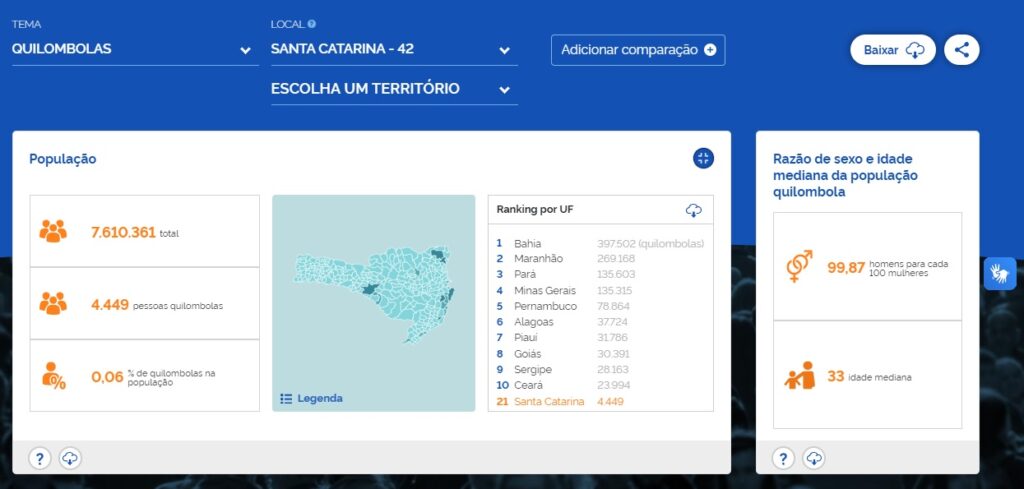
Santa Catarina
Santa Catarina has 7,610,361 inhabitants. Of these, 4,449 are quilombola people – representing 0.006% of the state’s population. They are in the municipalities of Abdon Batista; Águas Mornas; Araquari; Araranguá; Balneário Camboriú; Balneário Barra do Sul; Campos Novos; Capivari de Baixo; Cerro Negro; Criciúma; Florianópolis; Fraiburgo; Garopaba; Gravataí; Imbituba; It