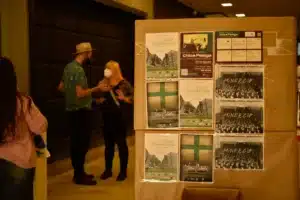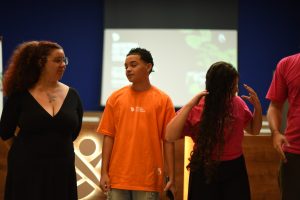

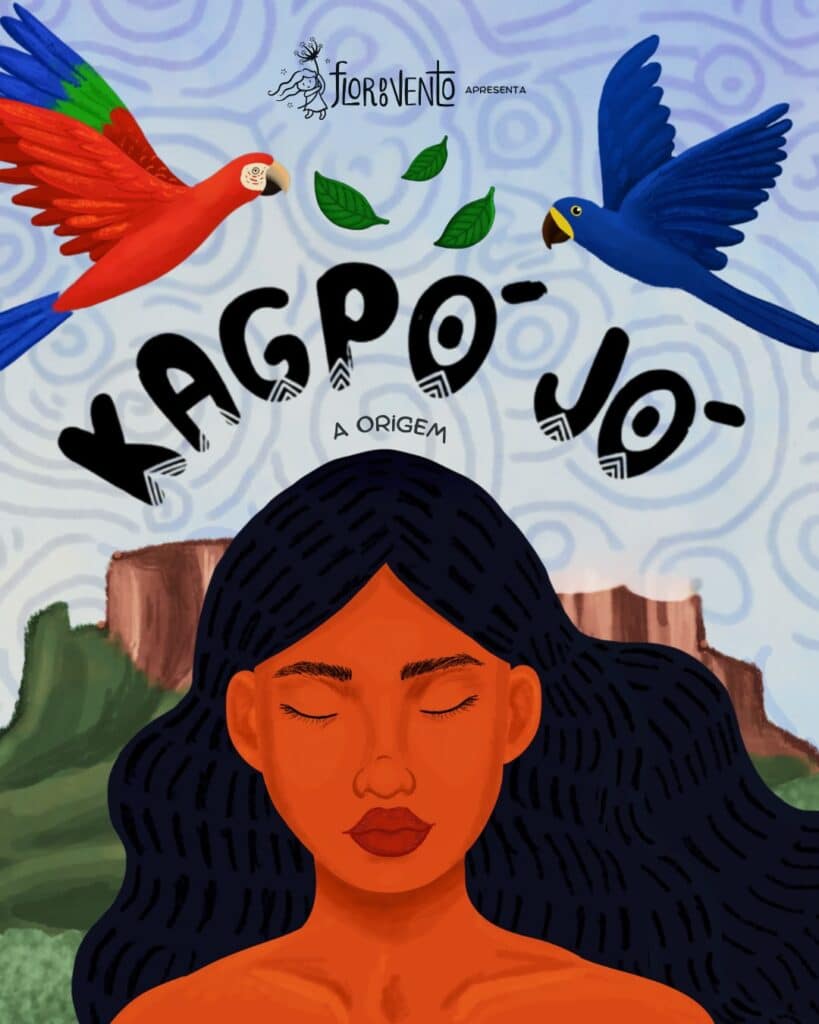
Origin. No better theme could have been chosen for the opening of the 4th Chica Pelega Film Festival, held on Monday evening (the 9th), at the Euclides da Cunha Municipal Library, in Videira. The short film Kagpó jó (The Origin) is the first animation made by Laklãnõ/Xokleng and Kaingang indigenous people, with narration in their mother tongue. In vibrant colors, the production speaks about the forces of nature and shows how the first people of the earth sprang forth.
“The film is born from migration; it came, in fact, through a trip I had the honor of making to Roraima, where I got to know an indigenous people different from my own and learn their history beyond ours. So it was born from that migration, from leaving the south for the north of the country,” says Jucelino Filho, director and screenwriter of the film.
Producer and screenwriter Fernando Xokleng highlights the importance of the film being produced by indigenous people. “We see many indigenous stories being told, but few stories told by us, indigenous people. Being able to tell a story ourselves, of our people, that was what most motivated us to be there every day, working and seeking knowledge to deliver the best to the audience.”
Direction and Screenplay by Jucelino Senei Filho (@jucefilho), Executive Production, Screenplay and sound by Fernando Xokleng (@fernando_xokleng) and Executive Coordination by Vanessa Fe-Há (@vanessa_fe_ha), both Journalism students at the Federal University of Santa Catarina (UFSC). Fernando is finishing the course this year and will be the first Laklãnõ/Xokleng indigenous person to obtain this degree.
About the Festival
The Chica Pelega Film Festival had its first screening in 2021, when a group of friends found themselves shocked by the questions surrounding their origins, always said to be “European.” They realized that, in the region where they were raised, a very important historical conflict took place, known as the Contestado War (1912-1916), yet little addressed in their school days – back in the 1980s-90s. Thus they began research into films that addressed this context.
The first edition, on August 23, 2021, at Cine Gracher, in Joaçaba, featured local and regional productions on this subject. The following year, other productions were added, still about the war scenario and its repercussions. This time, the films were screened in Campos Novos, Curitibanos, Caçador, Fraiburgo and Timbó Grande. In the third edition, the quilombola peoples were highlighted. It passed through Campos Novos, Monte Carlo, Fraiburgo and Capinzal. In the two following years, the quilombola edition traveled through quilombola territories across the state of Santa Catarina.
Now in this year of 2026, the Chica Pelega Festival brings productions that speak about migrations, giving special attention to the original peoples, distributed across the following categories: Contemporary Migrations shorts and features; Student; Childhoods on Screen; Catarinense; Contestado.
As one can see, it has always been about the origin. The contested region, where the war took place, was inhabited by indigenous peoples, by Black people – a region on the enslaved people’s route – and by the Europeans who migrated in the 19th century.
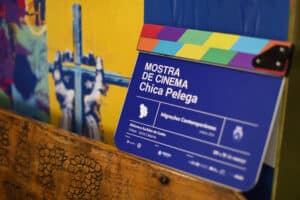
The 4th Chica Pelega Film Festival takes place from March 9 to April 9 in the online format and from March 9 to 19 in person, in Videira, in the Meio-Oeste region of Santa Catarina.
The awards ceremony airs on April 10, at 7 p.m., on YouTube.
For information about films, programme and venues, visit the Chica Pelega website or Instagram @mostra.chicapelega.